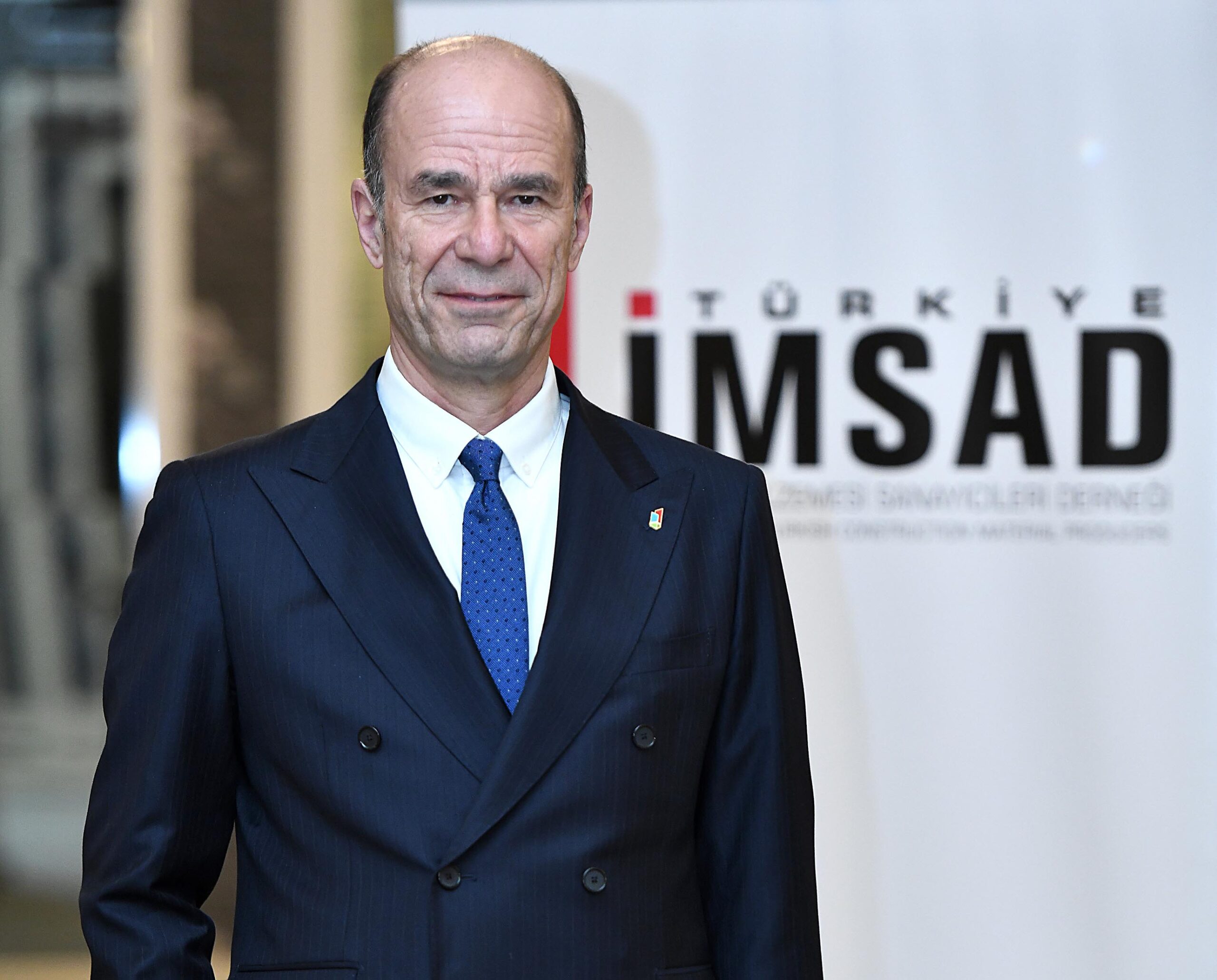
Tayfun Küçükoğlu
Chairman of the Board
Türkiye İMSAD
Despite ongoing global economic uncertainties and financial tightening, 2025 was a year in which recovery accelerated, and opportunities became more clearly visible for the Turkish construction materials industry. Thanks to its strong production infrastructure and high export capability, the sector managed this challenging period in a largely balanced manner.
In the domestic market, reconstruction activities in earthquake-affected regions and urban transformation projects were the main drivers supporting production. This process once again demonstrated the industry’s capacity to respond rapidly to domestic demand. In foreign markets, our export structure spanning nearly 200 countries provided significant resilience in terms of market diversification and strengthened Türkiye’s position in global competition.
As official data have not yet been announced, based on current indicators we expect the total size of the construction materials industry to reach approximately USD 165 billion by the end of 2025, with exports exceeding USD 31 billion. This expectation reflects our confidence in the industry’s production capability, logistics strength, and adaptability to global markets.
A Year Marked by Harmonized Progress of Domestic and External Dynamics
2025 was a year in which both domestic dynamics and export-oriented strategies worked in tandem, once again highlighting the resilience and strategic importance of the construction materials industry.
In 2025, the common agendas highlighted under the Türkiye İMSAD umbrella focused on maintaining short-term resilience while supporting long-term transformation goals. Global financial tightening and cost pressures made access to finance and cash flow management priority issues across many sub-sectors. During this period, inter-company knowledge sharing, early risk identification, and sectoral solidarity contributed to a more balanced management of the process across the industry.
Sustainable production, energy efficiency, digital transformation, and green transformation were shared priorities across all sub-sectors throughout 2025. The European Green Deal, carbon regulations, and environmental standards became strategic reference points, particularly for export-oriented companies, and played a decisive role in investment plans and production processes.
In the domestic market, reconstruction activities in earthquake-affected regions and urban transformation projects were among the key factors shaping production and capacity planning. In this context, the need for quality, sustainability, and long-lasting construction materials required sub-sectors to develop a common approach.
Export-Driven Growth and Competitiveness
Increasing exports, maintaining market diversification, and expanding into new markets were also among the shared agendas of Türkiye İMSAD members in 2025. While the geographically diversified export structure supported the sector’s resilience in global competition, digitalization, innovation, and compliance with international quality standards emerged as key drivers of competitiveness.
Beyond economic and technological transformation, the world is going through a multi-layered change process in which the environmental dimension is gaining increasing importance. While digital transformation is redefining production processes, the European Green Deal is fundamentally reshaping the rules of global trade and industrial competitiveness. In this new era, sustainability, efficiency, and competitiveness are no longer separate topics but integrated priorities that must be addressed together.
At Türkiye İMSAD, we approach this transformation not through short-term agendas but within a framework of shared direction and awareness. Green and digital transformation stood out as core common agendas throughout 2025, and the steps taken in these areas are among the key elements supporting our industry’s medium- and long-term competitiveness.
In 2025, the cement sector continued to be one of the fundamental pillars of the construction materials industry. Reconstruction efforts in earthquake-affected regions and infrastructure investments increased demand for cement and other heavy construction materials, strengthening the sector’s strategic position within the supply chain.
Throughout 2025, sustainable production, energy efficiency, and the reduction of environmental impacts became common orientations across all sub-sectors, including cement. These themes emerged as key determinants of competitiveness for the entire industry.
Towards 2026: A New Era Focused on Transformation
Looking ahead to 2026, digitalization, productivity enhancement, and environmental compliance are expected to come to the forefront in the cement sector, as in the broader construction materials industry. In the domestic market, urban transformation and renovation projects, and in foreign markets, carbon regulations and quality standards, form a common framework encompassing all sub-sectors and shaping the direction of industrial transformation.
Digital transformation, sustainability, and the Green Deal are positioned not merely as environmental or technological topics, but as strategic elements that transform the industry’s production, export, and efficiency structure. Digitalization is considered a tool that enhances efficiency across all sub-sectors, enables more effective resource use, and elevates quality standards.
Within this framework, the twin transformation—green and digital—has long been on our agenda and has now become a strategic necessity rather than a choice for our industry. However, with the Industry 5.0 approach, we recognize that transformation should not be limited solely to technology and environmental dimensions. At Türkiye İMSAD, we address this through the concept of “Triple Transformation”: digital transformation, green transformation, and social transformation. Social transformation encompasses a wide range of areas, from qualified employment and education to workplace culture and equal opportunity, ensuring that the steps taken are lasting, fair, and inclusive. Because no transformation that fails to place people at its center can achieve sustainable success.
Sustainable production, energy efficiency, and carbon management have become particularly decisive in export markets. The European Union’s carbon-neutral targets and renovation-focused transformation, along with demand patterns in major markets such as the United States, present new opportunities for the Turkish construction materials industry. At the same time, countries in our neighbouring regions undergoing reconstruction also support our industry’s production and export potential.
With the Industry 5.0 approach, we recognize that transformation should not be limited solely to technology and environmental dimensions. At Türkiye İMSAD, we address this through the concept of “Triple Transformation”: digital transformation, green transformation, and social transformation.
Türkiye’s Regional Manufacturing and Logistics Advantage
Türkiye’s advantage of being a logistics and production hub influencing a geography of 1.5 billion people constitutes one of the core pillars of this vision. When Anatolia’s historical production strength is combined with our industry’s engineering, innovation, and export experience, achieving a much stronger position in the medium and long term becomes possible.
As Türkiye İMSAD, our 2026 vision is built on an approach that encompasses all sub-sectors, prioritizes long-term thinking, and aims for our industry to emerge stronger from this transformation process. In line with this vision, we will continue to guide our members and contribute to the sector’s progress through collective wisdom.