Assoc. Prof. Dr. Ergin Gülcan
ergingulcan@hacettepe.edu.tr
Why Now?
Today, industry is going through a period in which raw material demand is increasing while environmental pressure is also growing. While circular economy targets are being discussed, the most fragile link of the “collection–sorting–recovery” chain is often overlooked: sorting quality. Because the real output of recycling is not “waste”; it is a secondary raw material whose chemical composition, density, and purity are defined. When these defined fractions cannot be produced with sufficient purity and continuity, reprocessing hits a scale and quality barrier. Moreover, this is not merely an issue of “efficiency”. While resource extraction and processing are associated with approximately 50% of global greenhouse gas emissions, it is known that their contribution to indicators such as biodiversity loss and water stress can exceed 90%. Nevertheless, the share of secondary raw materials in total material consumption in the European Union is still reported to be at the level of 12.7%. In the context of the cement sector, this situation clearly demonstrates that the quality–continuity equation (i.e., proper recovery) is critical for substitution targets to find real application in practice.
At this stage, sensor-based sorting (SBS) comes into play. SBS are dry process equipment that measure bulk material with sensors, classify it within milliseconds, and separate components by means of pneumatic ejection (air jets). Today, SBS have become widespread both in mining and recycling through the individual or hybrid use of sensors such as visual (RGB), near-infrared (NIR), X-ray transmission (XRT), X-ray fluorescence (XRF), and electromagnetic (EM). Separators dominated by XRT/DE-XRT sensors have a distinct importance in terms of their application potential and separation efficiency. This is because, in mineral-containing streams, recycling applications, and metal scrap, it is possible in many applications to determine quality by reading density/composition contrast independently of the surface. SBS can be a powerful tool for achieving two targets simultaneously in areas such as raw materials, recycling, and waste management. These are:
- Purity (quality): Reducing contaminants and meeting product standards
- Recovery (efficiency): Recovering the target material at the highest possible rate
What are Sensor-Based Sorters (SBS)?
In principle, SBS can be considered the modern, automated, and high-capacity continuation of manual sorting performed visually, first described by Georgius Agricola in 1556. Rickard’s emphasis in 1905 that “sorting is vital for mining economics” is equally valid today for the recycling economy.
XRT / DE-XRT Working Principle
The physical basis of XRT is simple but powerful: when X-rays pass through a material, their intensity decreases, and this attenuation is expressed by the Beer–Lambert approach (I = I0·e−µx). Here, µ is the absorption coefficient of the material, and x is the thickness traversed by the radiation. In practice, µ is related to density and atomic number. For this reason, XRT produces a strong separation signal in mixtures that exhibit differences in “atomic density” (e.g., gangue–ore, Al–Mg, inert–organic mixtures).
In single-energy measurements, thickness effects may complicate classification. In the dual-energy XRT (DE-XRT) approach, signals are collected in two energy bands, and by using the ratio/relationship of these signals, thickness effects are largely suppressed, enabling more stable separation. Particularly in heterogeneous streams (mine waste, C&DW, mixed scrap, etc.), this stability means “the ability to withstand wider feed fluctuations using the same equipment.”
In a belt-type XRT sorter, the typical flow occurs as (i) single-layer presentation of the material on the belt, (ii) detection of the transmitted X-rays, (iii) processing and classification of the image, and (iv) separation by pneumatic ejection (Figure 1). For example, for a system with a 1.2 m belt width operating at a belt speed of 3 m/s and equipped with a single sorter, the capacity for an average particle size of 40–50 mm can be approximately 65 t/h, and the equipment can capture images in two energy channels and perform classification at approximately 0.8×0.8 mm/pixel resolution (capacity may vary depending on application type and particle size).
The critical point here is calibration. Reference material is scanned with XRT; pixels are divided into absorption classes (e.g., high/medium/low), and a “cut-off” criterion is defined (Figure 2). In other words, with proper calibration, XRT produces not only an “image” but also a quality control/decision mechanism embedded within the process. Feasibility studies related to XRT applications in plants should only be carried out by qualified experts.
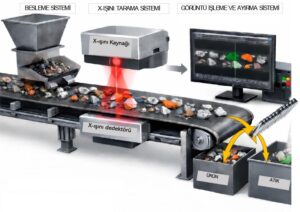
Figure 1: General components of XRT
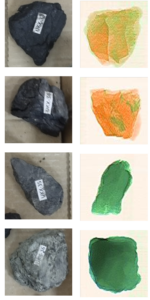
Figure 2: Images of different materials under XRT
Industrial Case Examples: The Impact of XRT-Based SBS in the Field
1. Some Applications in Mining
The most powerful use of SBS in mining is early-stage pre-concentration, in which the barren fraction is separated before entering the crushing–grinding–flotation stages. In this way:
- Grinding tonnage decreases: energy consumption and wear are reduced
- Feed load in beneficiation circuits decreases: water/reactant consumption and wastewater load are reduced
There are many successful examples of XRT applications in raw materials worldwide. At the Ben Guerir phosphate mine in Morocco, DE-XRT was applied to the >30 mm fraction for the recovery of phosphate remaining in mine waste stockpiles; as a result, the P₂O₅ content increased from 13.5% to 18.5%, while the P₂O₅ recovery was reported to be 70%. In another application, at the Ma’aden Umm Wu’al phosphate project in Saudi Arabia, it has been reported that operations are conducted with a feed rate of 1,800 t/h, a production scale of 13.5 Mt/year, and sorters with a belt width of 2.4 m; more than 70% of the ROM is separated by XRT, silica in the final concentrate can be reduced to 1–2%, and approximately 700,000 tons of high-grade concentrate can be produced annually. This application is frequently referenced in the industry as a “proven” example.
At the Barruecopardo tungsten operation in Spain, it is known that the placement of an XRT sorter at the beneficiation stage enables feeding the process with “higher initial grade,” thereby reducing costs.
It has also been reported by manufacturers that magnesium can be separated from mixed fractions such as “Zorba/Twitch” using XRT-based systems, enabling the production of “low-Mg Twitch,” and purity levels of 99% have been achieved in field tests.
2. Recycling (Municipal/Packaging/Scrap) Lines: High Purity, High Recovery
XRT technology is used at an industrial scale in the recycling sector, particularly as a component of SBS systems in streams containing high density and atomic composition differences. The most mature applications are observed in metal recycling; aluminum and non-ferrous metals present in mixed metal scrap (e.g., the Zorba fraction) and municipal solid waste incineration (MSWI) bottom ash are separated from the mineral matrix using XRT. Similarly, in wood recycling, XRT increases the quality of recovered products by separating low atomic density wood fractions from metal and mineral contaminants.
In the recycling of municipal and packaging waste, XRT is generally positioned within hybrid sorting lines integrated with NIR, RGB, and electromagnetic sensors. In these lines, plastic types are identified by NIR, while XRT plays a complementary role in removing mineral, glass, and metal-origin contaminants or in density-based fractionation. Thus, the purity of materials entering downstream processes is increased, indirectly reducing energy and resource consumption in melting, extrusion, or the use of substitute raw materials.
The fundamental challenge in recycling lines is managing the “speed + variable feed + purity” triad. Industrial facilities consist of combinations of crushers, screens, ballistic separators, air classifiers, and SBS units. In SBS, the flow proceeds through an identification–decision–separation cycle; particles are separated as product/waste by being ejected or dropped via air jets. To prevent performance losses in materials with continuously fluctuating input, approaches such as “digital twin” aim to simulate lines using real-time machine and material flow data and dynamically optimize parameters.
3. Construction/ Demolition Waste (C&D): A Critical Opportunity for the Cement Sector
In cement and aggregate applications, the obstacle to recovery is often contaminants (sulfates originating from gypsum/anhydrite, brick–concrete mixtures, wood–plastic, metals, fine fractions). The contribution of SBS is twofold:
- Quality: XRT’s sensitivity to density/atomic density is a powerful tool in separating mineral-origin fractions from light organic fractions and certain contaminants.
- Added Value: As purity increases, recovered aggregates/raw materials can shift from low-value filler use to higher-value applications; instead of “down-cycling,” high-quality substitute raw materials are created.
In more specific applications, it has been demonstrated that, in construction–demolition and wood waste streams, inert/ metallic contaminants can be separated with over 98% accuracy using an XRT sorter optimized for wood processing lines.
Technical Advantages Compared to Conventional Methods
1. Energy: The earlier the separation is performed (especially in mining), the more grinding and beneficiation tonnage is reduced. This has a direct impact on energy consumption and equipment wear.
2. Water: XRT-based separation is a “dry” process; by reducing the tonnage entering wet circuits, it provides indirect water reduction. Considering the water footprint of resource extraction, this is a strong sustainability argument.
3. Chemicals/Reactants: In flotation systems, reducing the feed load lowers reactant consumption and wastewater load; this benefit is clearly observed in industrial phosphate examples.
4. Emissions and Logistics: Transporting/grinding less tonnage reduces emissions originating from fuel and electricity. Additionally, some of the separated lithologies can be directed toward civil engineering applications, generating additional value.
5. LCA (Life Cycle Analysis) Impact: Literature emphasizes that substituting primary raw materials with secondary sources can significantly reduce environmental impacts. XRT is one of the “pre-treatment” technologies that makes this substitution possible while preserving quality, as it reduces unnecessary mass entering the most costly/intensive stages of the process.
Conclusion
In conclusion, XRT/DE-XRT-based sensor sorting technologies serve as a critical interface across a wide application spectrum extending from recycling to mining and the cement sector, transforming “waste” from merely separated material into defined, traceable, and industrially usable secondary raw materials. However, this transformation cannot be achieved simply by installing equipment in the field; it is only possible through interdisciplinary analysis of the mineralogical, physical, and chemical properties of the material, scientifically designed sensor–process matching, and data-based performance verification. Otherwise, sensor-based sorting remains at the level of a mechanical element operating far below its potential. Therefore, for recycling and raw material targets to contribute to sustainability in a meaningful way, advanced sorting technologies such as XRT must now be addressed not as an option, but as a necessity—solutions that are investigated by competent experts, proven applicable in the field, and whose life-cycle performance is clearly demonstrated.