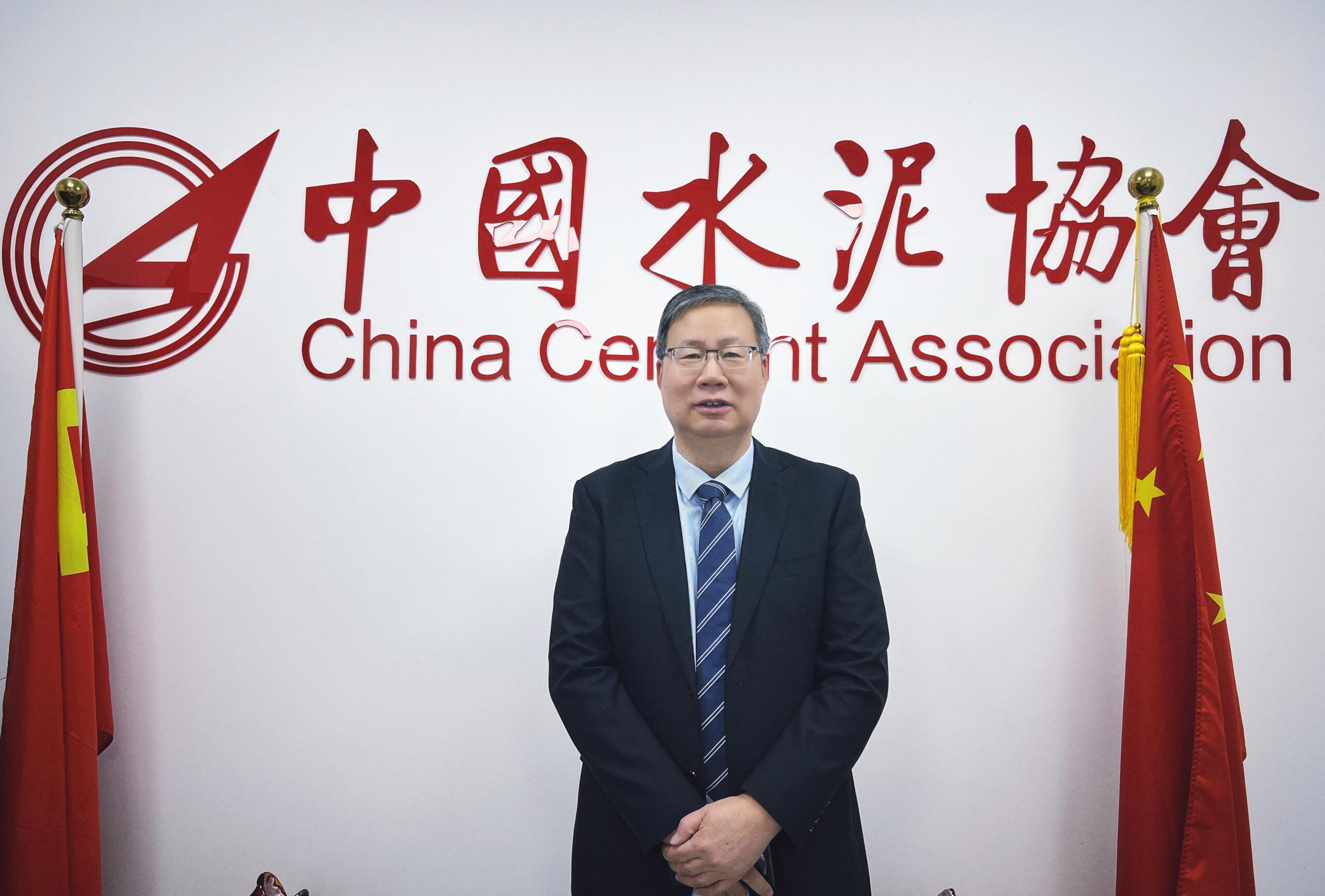
Wang Yutao
Executive Vice President and Secretary General
China Cement Association
In 2025, China’s cement industry faced dual pressures of continued demand contraction and structural overcapacity. National cement output in 2025 reached 1.693 billion tonnes, representing a year-on-year decline of 6.9% and marking the lowest level since 2010.
In terms of capacity management, amid severe overcapacity, capacity reduction has become the central challenge for achieving high-quality development in the cement industry. Through measures such as strictly prohibiting the addition of new clinker capacity, implementing capacity replacement on a net-reduction basis, and promoting consistency between actual operating capacity and registered capacity, alongside the comprehensive application of standards related to quality, environmental protection, energy consumption, and safety, outdated cement capacity is being phased out in accordance with laws and regulations. In 2025, approximately 300 clinker production lines implemented capacity replacement, cutting 160 million tonnes of clinker capacity.
Overseas Investments and Global Capacity Expansion
With regard to export policy, there are no specific domestic policies encouraging cement exports. Driven by domestic market pressures, China’s cement exports increased in 2025. According to customs statistics, total exports of cement and clinker reached 11.71 million tonnes in 2025, up 118% year on year. Of this total, cement exports amounted to 6.57 million tonnes, an increase of 31% year on year, accounting for 0.39% of total cement production, while clinker exports reached 5.15 million tonnes, representing a year-on-year increase of 1,392%. This growth was mainly attributable to companies’ proactive export strategies, competitive pricing, and stable demand in overseas markets.
In terms of overseas investment, as of the end of 2024, Chinese enterprises had cumulatively invested in the construction of 49 cement clinker production lines across 21 countries. Operational projects accounted for total clinker capacity of 67.08 million tonnes and cement capacity of 96.70 million tonnes. In 2025, overseas clinker capacity in operation is expected to exceed 90 million tonnes.
In China national cement output in 2025 reached 1.693 billion tonnes, representing a year-on-year decline of 6.9% and marking the lowest level since 2010.
The Core Axis of Transformation in 2025: Low-Carbon Production and Energy Efficiency
In 2025, low-carbon production and energy-efficiency practices serve as a key driving force for the industry’s transformation in the following aspects:
- Adapting to carbon market allowance allocation mechanisms and reducing compliance costs
2025 marks a critical year for the inclusion of the cement industry in China’s national carbon emissions trading system, under which carbon allowances are linked to output levels and emissions intensity. By adopting low-carbon production and energy-efficiency practices to reduce carbon emissions per unit of product, enterprises can secure more allowances or narrow allowance shortfalls while maintaining or even increasing output. This enables effective control of potential compliance costs and allows companies to prepare in advance for the possible implementation of an absolute cap on allowances from 2027 onward.
- Driving technological upgrades and achieving energy-efficiency benchmarks
The Special Action Plan for Energy Conservation and Carbon Reduction in the Cement Industry, jointly issued by the National Development and Reform Commission and other authorities, stipulates that by the end of 2025, at least 30% of production capacity should reach or exceed energy-efficiency benchmark levels, capacity below the baseline level should undergo technological upgrading or be phased out, and the comprehensive energy consumption per unit of clinker should be reduced by 3.7% compared with 2020. These requirements compel enterprises to enhance energy efficiency and reduce carbon emissions through technological innovations such as energy-saving retrofits, alternative raw materials and fuels, and carbon capture technologies, thereby further consolidating the foundation for high-quality industry development.
- Enhancing corporate competitiveness
Low-carbon production and energy-efficiency practices have evolved from mere “compliance requirements” into “core competitiveness.” They not only help reduce actual energy costs but also enable enterprises to convert emissions-reduction efforts into tangible economic returns through trading in the national carbon market. As such, these practices constitute a critical pathway for companies to build new competitive advantages under the carbon market framework, achieve long-term sustainable development, and represent an inevitable choice for enterprise survival and growth.
In 2026, the core task of China’s cement industry is to steadfastly advance supply-side structural reform under the overarching objective of “stabilizing growth,” while taking innovation as the fundamental driving force for consolidating its global standing.
The 2026 Outlook: Stable Growth and Global Competitiveness
In 2026, the core task of China’s cement industry is to steadfastly advance supply-side structural reform under the overarching objective of “stabilizing growth,” while taking innovation as the fundamental driving force for consolidating its global standing. In line with this strategy, the following priorities will guide efforts to strengthen China’s global competitiveness in the cement sector:
- Deepening capacity governance and increasing industry concentration
Industry concentration will be enhanced through mergers and acquisitions to optimize capacity allocation. Capacity replacement policies will be strictly implemented, with a firm prohibition on new clinker capacity and the continued elimination of outdated production capacity.
- Upgrading the product structure toward high-end applications
The industry will accelerate the application and development of special cements for sectors such as nuclear power and marine engineering, while advancing the research, development, and promotion of low-carbon cement products, including low-calcium clinker and novel carbon-sequestering cementitious materials. These efforts aim to meet the differentiated and high-end performance requirements of major national projects and green buildings.
- Innovation in low-carbon technologies
Priority will be given to the development of technologies such as high-rate alternative fuel substitution, hydrogen-fueled calcination, oxy-fuel combustion, and carbon capture, utilization, and storage (CCUS), in order to reduce carbon intensity. At the same time, the continued deployment of energy- saving technologies—such as low-resistance, high-efficiency preheater–precalciner systems, fourth-generation grate coolers, high-efficiency grinding systems, and intelligent kiln optimization and control systems—will promote the upgrading of energy-using equipment and enhance overall energy efficiency.
- Deep integration of digitalization and intelligent manufacturing
The industry will comprehensively advance the development of smart factories, leveraging industry-specific large models to optimize production control, quality forecasting, and supply chain management. This will enable real-time monitoring and intelligent dispatch of production, energy consumption, and emissions, with digital and intelligent technologies driving significant improvements in productivity and operational safety.
Looking at sustainable development, in the short term (2026–2030), the industry will continue to advance capacity governance and optimize industrial layout, phasing out outdated capacity in accordance with laws and regulations. China’s national carbon market will be further refined and improved, with more scientific and precise allowance allocation methods, a gradually tightening overall cap, and benchmarking against best-in-class industry performance. Ultra-low-emission retrofits will be essentially completed across the sector, comprehensively enhancing air pollutant control throughout all processes and stages of cement production, and achieving synergistic reductions of pollution and carbon emissions.
Efforts will be strengthened to encourage the use of industrial by-products—such as carbide slag, flue gas desulfurization gypsum, fly ash, and coal gangue—as raw materials for cement production, and to promote the co-processing of municipal solid waste and hazardous waste in cement kilns. These measures will improve the comprehensive utilization of resources, enhance the environmental value of the industry, and advance circular resource utilization.
At the same time, greater emphasis will be placed on R&D breakthroughs in advanced technologies, including hydrogen-fueled calcination, oxy-fuel combustion, suspension calcination, and carbon capture and utilization. Mature energy-saving and carbon-reduction technologies—such as low-resistance cyclone preheaters, high-efficiency calcination systems, high-efficiency grate coolers, energy-efficient grinding, alternative raw materials and fuels, and the utilization of renewable energy—will be widely deployed. These initiatives will further increase the share of capacity operating at energy-efficiency benchmark levels, continuously reduce carbon intensity, and drive the industry’s green and low-carbon transformation and upgrading.
Looking at the medium to long term (2030 and beyond), low-carbon technologies such as oxy-fuel combustion and CCUS will be gradually scaled up, steering the cement industry toward carbon neutrality. Cement plants will transition toward “Six-Zero” factories—zero externally purchased electricity, zero fossil energy, zero primary resource consumption, zero carbon emissions, zero waste discharge, and zero frontline workers. A number of integrated demonstration plants will be developed, incorporating elements such as energy self-sufficiency, resource circularity, carbon capture, and intelligent manufacturing.
Focusing on digital transformation, in the foundation-building stage (2026–2027), Building on existing smart manufacturing demonstration plants, advanced-level intelligent factories, and benchmark digital transformation cases in the building materials industry, efforts will continue to promote the comprehensive deployment of intelligent control systems across the cement sector. Digital infrastructure gaps will be addressed, data acquisition coverage for production management will be significantly expanded, and the automation rate of key production processes will reach 90%. R&D investment in 5G, big data, and artificial intelligence will be intensified, and a sound digital transformation standards system will be established to lay the groundwork for large-scale implementation.
In the integration and upgrading stage (2028–2030), AI technologies will be widely applied in production scheduling, quality control, and equipment maintenance. Digital twin technologies will empower plant design and operations, enabling full-scenario digital operations across production, supply chains, marketing, and management, and delivering substantial improvements in productivity.
In the ecosystem-building stage (2030 and beyond), an industrial internet ecosystem for the cement industry will take shape, enabling interconnectivity and data sharing across the entire industrial chain and promoting deep integration of “intelligent manufacturing + green manufacturing.”
International Cooperation and Global Integration
Focusing on international cooperation, China’s cement industry will deepen international cooperation on three levels. First, technology sharing: jointly advancing R&D in cutting-edge low-carbon and intelligent technologies, organizing international industry forums and technical seminars, and fostering two-way learning from global best practices. Second, market co-development: under frameworks such as the Belt and Road Initiative, the industry will upgrade from the export of individual engineering equipment to the provision of integrated “system solutions” encompassing investment, operations, and technology. Third, rule co-discussion: actively participating in global dialogues and standard-setting related to cement product carbon footprint standards, carbon market rules, and low-carbon technology specifications, thereby promoting a fair transition and sustainable development of the global cement industry.