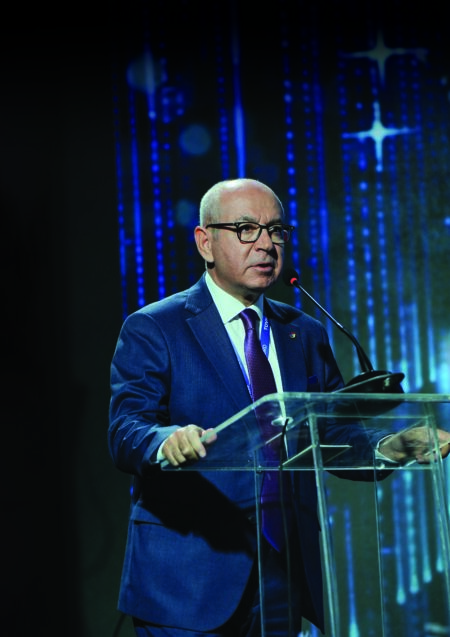
Compared to traditional Portland cements, LC3 (Limestone Calcined Clay Cement) stands out for its significantly lower environmental impact and its potential to advance sustainability goals in the cement industry. Thanks to the synergistic reaction between calcined clay—recognized as a pozzolanic material for over a century—and limestone, high substitution levels can still achieve comparable strength. This technology not only meets the increasing cement demand in developing countries but also makes a substantial contribution to reducing global CO₂ emissions.


Prof. Karen Scrivener – EPFL
What are the scientific backgrounds of LC3 research and the innovations it offers?
Blended cements containing slag and fly ash have been used for many decades; however, the global availability of these materials is quite limited. Therefore, to continue to decrease the clinker factor we need to find other SCM’s. In fact, calcined clays have been known for a long time and have been studied as pozzolanic materials for at least a hundred years. The real innovation of the LC3 research was the realization that a synergistic reaction occurs between the alumina in the calcined clay and the limestone, and that this reaction enables the maintenance of higher strengths even at higher substitution levels.
The potential of LC3 to reduce CO₂ emissions can be estimated in several ways. For example, if we compare CEM I (pure OPC) with LC350, they have roughly equivalent performance, but LC350 produces approximately 40% lower CO₂ emissions. If we look at a global level, we can consider the clinker factor. At present, the worldwide average clinker factor is approximately 80%. If we could reduce this to 60%, it would be equivalent to saving 400 million tons of CO₂ per year. Further decreasing it to approximately 45% could potentially double this saving to around 800 million tons of CO₂ per year. To put this into context, that represents roughly 1–2% of global CO₂ emissions.
If we compare CEM I (pure OPC) with LC350, they have roughly equivalent performance, but LC350 produces approximately 40% lower CO₂ emissions. If we look at a global level, we can consider the clinker factor. At present, the worldwide average clinker factor is approximately 80%. If we could reduce this to 60%, it would be equivalent to saving 400 million tons of CO₂ per year. Further decreasing it to approximately 45% could potentially double this saving to around 800 million tons of CO₂ per year.


This technology is particularly important for developing countries, where the demand for cement is expected to increase. Although there is significant clinker overcapacity in many parts of the world, only a few regions are expected to see a rise in demand over the next few years, with Africa being the most notable. Africa presents a particularly interesting case because limestone reserves on the continent are highly heterogeneous.
Many countries import clinker. By replacing a portion of this imported clinker with calcined clay, which is super abundant in Africa, these countries could not only lead to a worldwide reduction in CO₂ emissions but also create local employment and help the trade balance of their countries.
How would you explain the roles of limestone and calcined clay in the production process of LC3?
The role of calcined clay is to act as a pozzolan. The silicate components of the calcined clay react with calcium hydroxide to form additional CSH. Additionally, the alumina content can partially incorporate into the CSH, but it can partly react with limestone in a synergistic reaction.
But limestone also plays another role. Although only a small portion of the limestone reacts, its presence provides significant benefits: it not only improves workability but also, through its filler effect, stimulates the reaction of the clinker.
Compared to traditional Portland cement, what are the performance differences of LC3?
At a 50% substitution level, roughly the same strength as CEM I can be achieved. At the same time, with respect to durability, the ingress of chloride is dramatically slowed down by a factor of approximately 10, and these materials do not give any problem with alkali silica reaction. On the other hand, as with all blended cements, even with slag or fly ash, there will be somewhat faster carbonation. However, we have shown that despite the slightly higher carbonation rate, it still meets the standards of most countries for a design life of 50–100 years.
With the criteria for selecting raw materials, especially for calcined clay, you need a clay that contains some kaolin. Generally, we say a threshold is of about 40% clay is good but in fact we can even observe some pretty good performance down to kaolin content of 30%. It is also important to mention that for limestone, we can work with very low-purity limestones because we do not need to worry about magnesium or silica. As long as you have 50–70% calcium carbonate, these are acceptable. Regarding geological diversity you need to examine the local geology and have a strategy for sampling. First of all, this involves reviewing published geological maps, and we can provide all these services through our technical resource centers.
Large-scale trials are especially interesting, and what is particularly important in industrial trials is that the aspects of grinding and blending processes are much more better in an industrial context than in laboratory. For example, we have the case of LC3 production in Switzerland by DuraCement. With a clay, containing quite a low amount of kaolin, they can still produce a cement which is matching the OPC reference at two-day strength. This is due to the efficient grinding and use of grinding aids. They have similar experience in Ghana with their new LC3.
For governments and policymakers, first of all, it is important to better understand what proportion of their country’s emissions comes from cement. Worldwide, this figure is around 8%, but it varies considerably between countries. For example, in the USA, cement production accounts for only about 1.5% of emissions, whereas it may be above 15% in many developing countries, such as Vietnam and Nigeria.
Governments need to understand just how much adoption of LC3 can help them meet their targets for CO₂ reduction. Also, policymakers need to better understand that cement is now truly a global business, with exports of clinker, and this needs to be considered in the accounting scheme.
In the USA, cement production accounts for only about 1.5% of emissions, whereas it may be above 15% in many developing countries, such as Vietnam and Nigeria.
How do you foresee the global market share of LC3 in the cement industry over the next 10 years?
The potential is to easily achieve a worldwide clinker factor below 60%, which would mean the production of calcined clay is about 300 million tons of worldwide.
Apart from LC3, which other promising alternatives do you see in cement chemistry?
I think it is really important to say that the potential of LC3 is much higher in terms of both the scale and the speed at which it can be adopted. Many times, we encounter situations where socalled “wonder solutions” are proposed; however, when these solutions are examined in detail, it is evident that they do not lead to any significant progress. For example people have been looking at alkali activated materials or geopolymers for well over 60 years now and we really see total insignificant adoption in the market and the reasons for this are clear. You simply do not have the right raw materials for these alkali-activated materials — for example, slag, which works best. We have only about 10% of the slag compared to cement demand, and almost all of it is already being used in cement and concrete. Moreover, slag quality is highly variable, so its performance in the field is not robust. You can end up with many materials that either do not set at all or set too quickly, and they are often much more expensive. Nobody has been able to bring these materials to the market for less than double the price of conventional cements.
Therefore, I do not think there are any other promising alternatives. I believe it is not correct to speak of a single solution here. There are multiple solutions at the cement, concrete, and structural levels.
On the basis of strength, a 50% substitution level can achieve roughly the same strength as CEM I.
What would you suggest to your students and young researchers in this field?
It is really important to highlight that there are still a lot of aspects of the basic performance of cement and concrete that we do not fully understand. For example, the hydration process is essential to everything that happens, yet very few people around the world are actively studying it. This has been a major focus of research in my laboratory for the past 20 years. We have really made a lot of progress on this. We have shown that up to the end of the induction period, the rate of reaction is controlled by the dissolution of alite.
But after we start the main reaction of the silicate phases, it is actually the growth of calcium silicate hydrate, and there are various means by which we can manipulate this growth of calcium silicate hydrate to speed up strength development. If we speed up strength development, we can reduce the clinker factor, because what really limits the clinker factor is always the early-age performance.
It is easy to achieve performance at 90 days or six months, but in modern construction, we cannot wait that long before building the next part of the structure. For me, understanding hydration and exploring how we can manipulate the growth of CSH is still one of the most exciting things, but I think it all comes down to this connection. It is about connecting what happens at the cement, concrete, and structural levels, and breaking down the silos that people are currently working within.